The Space Between: What Happens Between Diagnosis and Decision?
There is a period of time that has fascinated me ever since I held my son Cade in my arms for the first time.
It wasn't the diagnosis itself.
It wasn't the decision.
It was everything that happened in between.
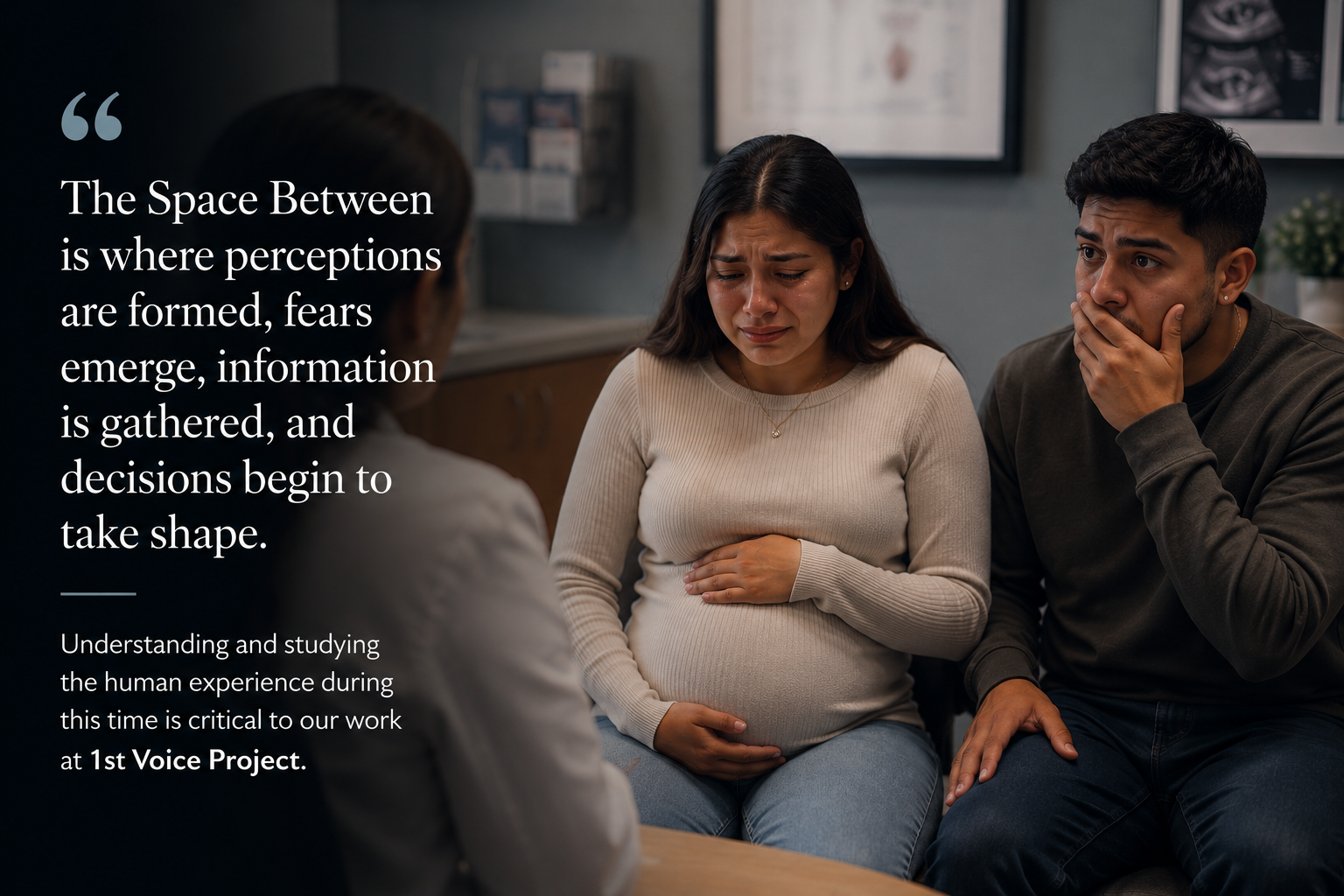
At the 1st Voice Project, we call this period The Space Between—the time between receiving a Down syndrome diagnosis and forming perceptions, seeking information, accessing support, and making decisions about the future.
For some families, The Space Between lasts hours.
For others, it lasts days, weeks, and months until birth.
For many, it becomes one of the most emotional and vulnerable periods of their lives.
Before we go any further, I want to say something important.
No matter what path your journey took—whether you continued your pregnancy, experienced a loss, pursued adoption, or chose termination—this project is not about judgment.
It is about understanding.
As a mother, a woman, and a human being, I understand how overwhelming this experience can be. The fear, uncertainty, grief, confusion, and isolation are real. Every family enters The Space Between carrying their own values, beliefs, experiences, circumstances, and hopes for the future.
Our goal is simply to better understand what happens there.
Entering The Space Between
The Space Between begins the moment a diagnosis enters your life.
For some families, that moment comes through a positive NIPT result.
For others, it comes after an amniocentesis, a conversation with a genetic counselor, or a diagnosis delivered after birth.
The diagnosis may arrive:
In a doctor's office
Through a phone call
During a hospital stay
Through a patient portal such as MyChart
Regardless of how it arrives, something changes.
Suddenly, parents find themselves trying to imagine a future they know very little about.
Questions appear immediately:
What does this mean for my baby?
What does this mean for my family?
What challenges will my child face?
What kind of life will they have?
What should I do next?
Most parents begin searching for answers immediately.
I know I did.
The Search for Answers
When I received my diagnosis, I consumed everything I could find.
Medical articles.
Statistics.
Parent stories.
Social media.
Google searches.
Anything that might help me understand what was happening.
Looking back, what fascinates me is not simply the information I consumed, but how I interpreted it.
When I was frightened and overwhelmed, every statistic felt larger.
Every risk felt certain.
Every challenge felt inevitable.
I remember reading lists of medical conditions associated with Down syndrome and feeling convinced my child would experience every one of them.
Today I understand those resources differently.
But in that moment, I wasn't reading as a researcher.
I was reading as a terrified mother.
That distinction matters.
The Weight of Words
One of the themes we are studying at the 1st Voice Project is what we call The Weight of Words.
Who delivered the diagnosis?
How was the information framed?
What statistics were shared?
What recommendations were made?
How much trust did parents place in those sources?
When information comes from doctors, genetic counselors, nurses, and other trusted professionals, it often carries extraordinary influence.
This is especially true during periods of uncertainty.
For first-time parents, that influence may be even greater.
When you have never navigated pregnancy, parenthood, or a major medical decision before, it can be difficult to know what questions to ask or whether seeking additional perspectives might be helpful.
Many experienced parents learn over time to seek second opinions and gather multiple viewpoints before making significant decisions.
But first-time parents may not yet have developed that confidence.
This is one of the reasons we believe The Space Between deserves closer attention.
Expectations and Reality
One of the most surprising things about becoming a parent is discovering how different reality can be from expectation.
Before children, many of us carry an image of what parenthood will look like.
Then life happens.
Children arrive with their own personalities, strengths, challenges, and surprises.
Parenthood becomes something far richer and more complicated than we imagined.
I believe this is especially relevant to prenatal diagnoses.
When families receive a diagnosis, they are often asked to imagine an entire future based on limited information during one of the most emotional moments of their lives.
Many parents later describe a reality that looks very different from what they envisioned during those early days.
Understanding that gap between expectation and reality is one of the questions that sits at the heart of this project.
Why The Space Between Matters
The Space Between is where perceptions are formed.
It is where fears emerge.
It is where information is gathered.
It is where trust is placed.
It is where decisions begin to take shape.
And yet, it remains one of the least understood parts of the diagnosis experience.
Through the 1st Voice Project, we hope to learn more about what families experience during this critical period and how communication, resources, support systems, and personal circumstances influence the journey.
If you have received a prenatal or postnatal Down syndrome diagnosis, we invite you to share your experience.
Because understanding The Space Between begins with listening to the people who have lived it.
A note from the 1st Voice Project:
Have you experienced the Space Between? If so, The 1st Voice Project would like to hear about your experiences. Please consider taking a few minutes to contribute to our project.
Are you currently in the Space Between? If so, we are here to support you and answer any questions you may have. Please visit this page for resources:
Related articles:
10 Things I Wish Someone Told Me when I was pregnant
The Seven Fears Many Parents Carry During "The Space Between"
What I Expected vs. What I Experienced Raising a Child with Down Syndrome
Why Parents Remember the Diagnosis Conversation for Years
Outdated Stereotypes That Still Shape Modern Down Syndrome Diagnoses
Help other families find balanced information by sharing this article.