The 7 Fears Many Parents Carry During "The Space Between"
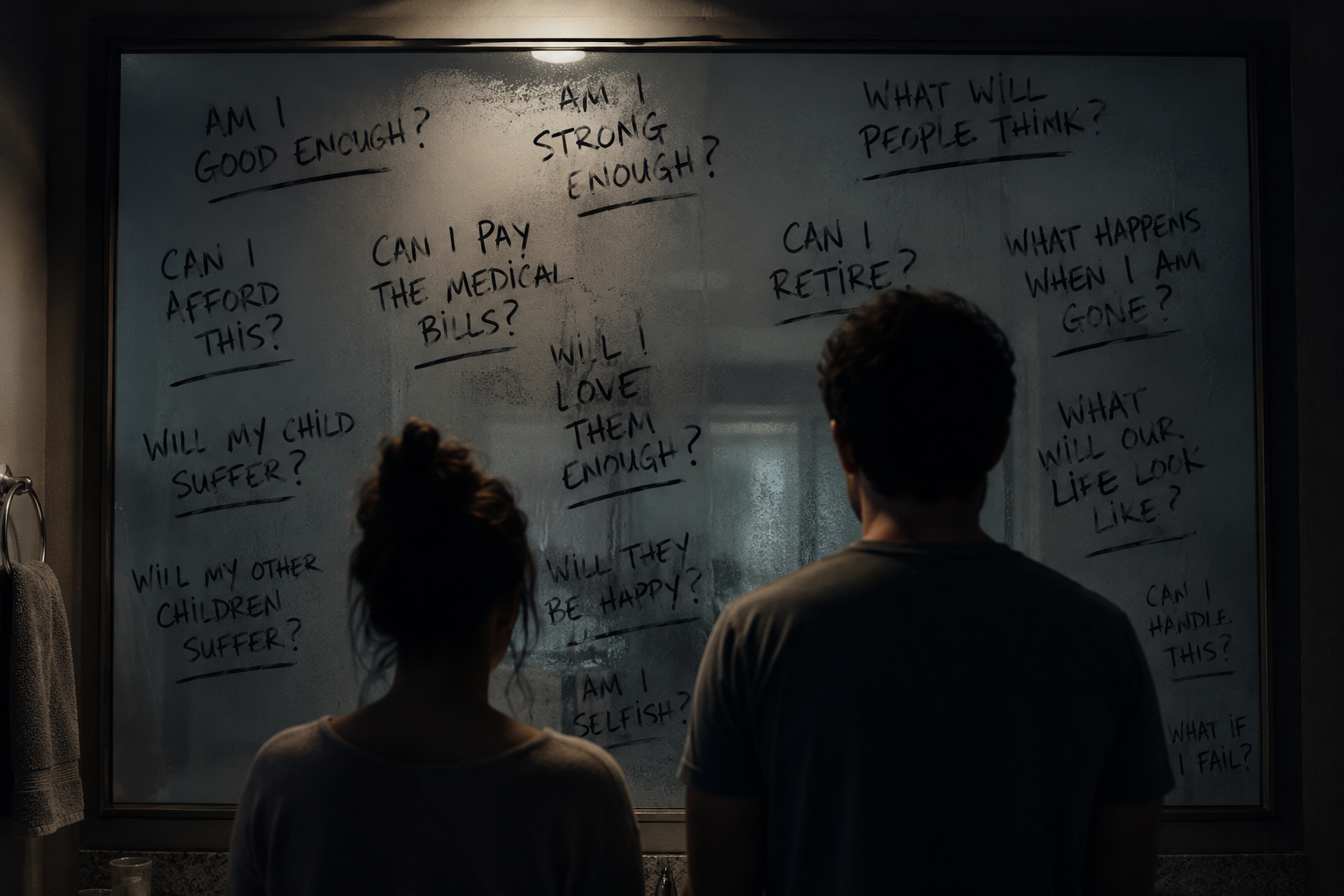
There are fears that parents say out loud after a Down syndrome diagnosis.
And then there are the fears many of us carry quietly.
The ones we feel ashamed to admit.
The ones that make us question not only the diagnosis, but ourselves.
When I received my prenatal Down syndrome diagnosis, I was terrified. I had three children already. I had experience with special needs. I had a supportive husband. I had stability in my life.
And still, I was afraid.
That fear is one of the reasons the 1st Voice Project exists.
We are trying to better understand what parents experience during what we call The Space Between—the critical period after diagnosis when families are processing information, searching for answers, forming perceptions, and making decisions about the future.
During that time, fear can become incredibly powerful.
Not because parents are weak.
Because they are human.
1. Fear of Serious Medical Problems
For many parents, the first fears are medical.
Will my baby survive?
Will they need heart surgery?
Will they have cancer?
Will they suffer?
Will their life be filled with hospitals, specialists, and procedures?
When a diagnosis is delivered, parents are often given a list of possible medical complications associated with Down syndrome. That information may be medically accurate, but when received in a state of fear, it can feel overwhelming.
I remember reading through lists of possible health concerns and feeling as if my child might have all of them.
Heart problems.
Leukemia.
Stillbirth.
Feeding issues.
Developmental delays.
I know now that possible does not mean certain.
But in that moment, I was not processing information as a researcher.
I was processing it as a terrified mother.
2. Fear of the Unknown
One of the hardest parts of receiving a diagnosis is trying to imagine a future you have never seen.
Many parents have little or no personal experience with Down syndrome before diagnosis.
They may not know adults with Down syndrome.
They may not know families raising children with Down syndrome.
They may only know stereotypes, outdated images, medical descriptions, or worst-case scenarios.
That leaves a terrifying blank space.
What will my child be like?
Will they talk?
Will they walk?
Will they go to school?
Will they have friends?
Will they be happy?
Will we be happy?
The unknown can feel heavier than the diagnosis itself.
When I was pregnant, I could not picture my future with a child with Down syndrome. No matter how hard I tried, I could not see myself in that role.
That inability to picture the future was one of the most painful parts of my pregnancy.
3. Fear of Not Being Able to Handle It
A diagnosis does not only make parents question the future.
It can make them question themselves.
Am I strong enough?
Can I do this?
Will I be patient enough?
Will I fail my child?
Will I become overwhelmed?
For me, this fear was intense. I worried that I was not the kind of person who could handle raising a child with Down syndrome.
I questioned my own strength.
My own character.
My own goodness.
I wondered what it said about me that I was so afraid.
Looking back, I wish someone had told me that fear is not proof that you are incapable.
Fear is often just what happens when love meets uncertainty.
4. Fear of the Impact on Siblings and Family
Many parents worry about how a child with Down syndrome will affect the rest of the family.
Will my other children suffer?
Will they miss out?
Will they become caregivers?
Will this place stress on my marriage?
Will our family life become harder?
This fear is common, and it deserves to be acknowledged with compassion.
But it is also one of the places where many families later describe a profound gap between expectation and reality.
In my experience, Cade has not been a burden to his siblings.
He is adored.
He is included.
He is celebrated.
He has brought something beautiful into our family that I could not have understood before he arrived.
That does not mean every moment is easy.
It means that fear did not tell the whole story.
5. Fear of Lifelong Dependence
This is one of the biggest fears parents carry.
What happens when I am gone?
Will my child live independently?
Will they need lifelong care?
Who will take care of them as an adult?
This fear can feel enormous because it stretches decades into the future.
A parent may be sitting in a doctor's office, newly pregnant, trying to absorb a diagnosis—and suddenly imagining adulthood, housing, finances, caregiving, siblings, and life after the parents are gone.
That is too much for one moment.
It is also why balanced information matters.
Families need realistic information about support, services, education, independence, employment, community living, and the wide range of outcomes for individuals with Down syndrome.
They do not need false promises.
But they also do not need to be handed only the heaviest possible version of the future.
6. Fear of Social Judgment
This fear is quieter, but very real.
What will people think?
Will people pity my child?
Will people pity me?
Will people stare?
Will my baby be accepted?
Will people see my child before they see the diagnosis?
I remember worrying about things I felt ashamed to admit.
Would my baby be cute?
Would people see him as beautiful?
Would I?
Those thoughts were painful because they forced me to confront parts of myself I did not like.
But I think this is part of the diagnosis experience that many parents quietly carry.
A diagnosis can expose not only our fears about disability, but also the stereotypes and assumptions we have absorbed from the world around us.
That does not make someone bad.
It makes them human.
But it also shows why representation matters.
Why real stories matter.
Why meeting families matters.
Why seeing children and adults with Down syndrome living full, meaningful lives matters.
7. Fear of Loving Differently
This is the fear I almost never wanted to say out loud.
What if I do not love my baby the same?
What if I feel differently?
What if I resent the diagnosis?
What if I am not the mother this child deserves?
That fear sat deep inside me during my pregnancy.
And then Cade was born.
The moment I saw him, I was not looking at Down syndrome.
I was not looking at a chromosome.
I was not looking at a diagnosis.
I was looking at my son.
The love was immediate.
The same overwhelming, unconditional, motherly love I had felt with my other children.
The fear that I would love him less disappeared in an instant.
And that is part of what has haunted me ever since—not because the outcome was bad, but because the reality was so different from what I had feared.
Why These Fears Matter
The purpose of naming these fears is not to shame parents.
It is the opposite.
It is to tell the truth about how heavy this period can be.
During The Space Between, parents are not just processing medical information.
They are processing identity.
Family.
Faith.
Finances.
Marriage.
Parenthood.
Their own capacity.
Their own values.
Their own assumptions.
Their own fears.
And sometimes, their own shame.
That is a lot to carry.
The 1st Voice Project is studying this space because these fears may shape how families interpret information, seek support, and make decisions.
We want to better understand what parents feared, where those fears came from, what information influenced them, and how those fears compared to what families ultimately experienced.
Because if we want to improve the diagnosis experience, we need to understand the human experience.
Not just the medical one.
If You Are In This Space Right Now
If you recently received a Down syndrome diagnosis and you are afraid, I want you to know something:
Your fear does not make you a bad parent.
Your questions do not make you weak.
Your uncertainty does not mean you are not capable of love.
You are standing in a moment that is emotionally enormous.
Take your time.
Seek balanced information.
Talk to medical professionals.
Talk to families.
Talk to adults with Down syndrome when possible.
Let yourself breathe before allowing fear to write the whole story.
Because fear may be part of the beginning.
But it does not have to be the whole journey.
A note from the 1st Voice Project:
Have you received a positive prenatal screening or Down Syndrome diagnosis? If so, the 1st Voice Project wants to hear about your worries and fears. Please take a few minutes to take our survey and share your experiences.
Related articles:
10 Things I Wish Someone Told Me when I was pregnant
The Space Between: What Happens Between Diagnosis and Decision?
What I Expected vs. What I Experienced Raising a Child with Down Syndrome
Why Parents Remember the Diagnosis Conversation for Years
Outdated Stereotypes That Still Shape Modern Down Syndrome Diagnoses
Help other families find balanced information by sharing this article.